
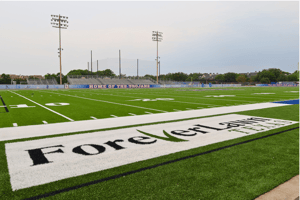
When a local 4th-grade football game in Richardson revealed how worn synthetic turf affects safety and performance, ForeverLawn Texas owner Nick Pavey saw firsthand why warranties and product quality matter more than price tags.
Game Day Reality
Last Saturday, November 1, I stepped onto the football field at Berkner High School to coach my son’s 4th-grade Richardson Raptors team. From the first few steps, something felt off. When I planted and cut, my cleats slid like I was on marbles. The turf fibers were nearly gone, snapped, and flattened into the rubber infill. After the game, my daughter ran across the field, and when we got home, her socks were covered in tiny turf strands. Even doing laundry the next morning, I cleared the lint trap and pulled out a handful of shredded turf fibers.
Why That Matters
When turf fibers break down, athletes lose traction and stability. The infill shifts, creating inconsistent footing and poor shock absorption. Those changes increase the likelihood of lower-extremity injuries—ankle sprains, ACL tears, and hip slips. A field’s playability depends on three main factors: fiber integrity, infill stability, and G-max performance (impact absorption). Once the fiber collapses and infill migrates, the field may technically still be 'within the warranty standards' but it’s no longer performing safely.
An Aging Field
I later checked: Berkner’s field was replaced in 2017 as part of a Richardson ISD bond package—making it about eight years old. That’s near the end of life for many synthetic turf systems. Heavy use from football, soccer, and band accelerates wear. So while the field’s condition isn’t surprising for its age, it’s a reminder that 'within the warranty standards' doesn’t always mean 'in playable shape.'
A Similar Story at Trinity Christian Academy
When we replaced Trinity Christian Academy’s field in the summer of 2024, it was in nearly the same state. They had kept it two or three years longer than they wanted to. TCA shared the warranty for their old field—a 10-year non-prorated manufacturer warranty. What caught my eye was a clause that allowed up to 50 percent fiber loss before the field would be considered defective. In other words, the warranty only triggered after the turf was already unsafe for athletes. That’s not unusual. Many large manufacturers use similar language. Some warranties specify that the turf must retain at least half of its pile height or face weight before it’s eligible for replacement. The result? A field can be slick and worn out, but still be technically 'within spec.'
Choosing a Different Standard
When TCA started evaluating replacement options, we introduced them to SportsGrass by ForeverLawn—the same product installed at the NFL Hall of Fame Village in Canton, Ohio. SportsGrass Max is engineered and tested to exceed both NFL and FIFA safety and performance standards. That’s difficult to achieve—football demands traction and shock absorption; soccer demands true ball roll and even resilience. TCA ultimately chose ForeverLawn not only for its performance but also for its support. When they called a few weeks ago with two minor issues, our team was there the next day. That responsiveness matters as much as the turf itself.
What Turf Warranties Actually Cover
Most major manufacturers’ sports-field warranties cover defects in materials or workmanship (fiber, backing, seams), UV degradation or excessive fading, and occasionally, 'general wear from UV degradation'. They almost always exclude normal wear and tear, improper use, vandalism, or acts of God. Some warranties guarantee that the turf will retain at least 50% of its original fiber height or weight before coverage applies. Others use prorated coverage, meaning the longer you’ve owned the field, the less you’re reimbursed. ForeverLawn’s SportsGrass Max warranty is different: 10 years, non-prorated, full material coverage with a Closed Loop Warranty System.
Understanding the Gap Between 'In Warranty' and 'Safe to Play'
When schools or cities look at warranties, it’s easy to assume that a '10-year warranty' means a '10-year field.' But warranties protect against manufacturing defects, not aging performance. That’s why it’s critical to read the fine print—does the warranty allow major fiber degradation before coverage applies? Is it prorated or full coverage? Does it include UV and general wear, or just defects? Who handles maintenance to keep it valid? The difference between 'still covered' and 'still safe' can be years apart.
Final Thoughts
Walking onto that field at Berkner reminded me that a turf field isn’t just an investment in facilities—it’s an investment in safety. Most warranties protect manufacturers from defects, but not athletes from under-performing fields. Reading those fine-print details—fiber retention, prorating, and response time—makes all the difference. When schools, cities, and athletic directors compare bids, price should never be the only metric. The true measure is how long the field performs safely and how the company responds when it doesn’t.
At ForeverLawn Texas, we’re committed to building fields that hold up—because our players, our kids, and our communities deserve surfaces that perform as hard as they do.
Written by Nick Pavey, ForeverLawn Texas. For field assessments or warranty consultations, visit https://www.foreverlawntexas.com