
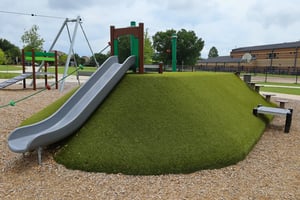
Critical fall height (CFH) is the tallest fall a playground surface has been tested to handle. More precisely, it approximates the maximum fall height from which a life-threatening head injury would not be expected to occur. A surface is only appropriate under a piece of equipment if its critical fall height is at least as tall as the highest designated play surface on that equipment.
That's the short answer. Here's what's behind it, and what it means when you're writing a spec or reviewing a bid.
Fall height vs. critical fall height
These two terms get mixed up, so it helps to separate them.
Fall height belongs to the equipment. It's the vertical distance from a designated play surface, like a platform or the top of a slide, down to the ground surface below it.
Critical fall height belongs to the surfacing. It's a test result that says how much fall that surface can absorb before it stops meeting the standard.
The job of the spec writer is to make sure the second number is at least as big as the first.
How critical fall height is tested
The test method is ASTM F1292. In a lab, an instrumented headform is dropped onto the surfacing from a series of heights, and sensors measure the impact. Two numbers come out of it:
- Gmax is the peak deceleration of the headform on impact. It measures how hard the hit is. The limit is 200.
- HIC, or Head Injury Criteria, accounts for how long that deceleration lasts, not just how high it peaks. The limit is 1,000.
The critical fall height is the highest drop height where the surface stays under both limits. Lower numbers mean the surface absorbed more of the impact.
Our third-party lab reports for Playground Grass™ by ForeverLawn® reference both ASTM F1292 and ASTM F3351-19.
What changes the number
Critical fall height is not a property of turf alone. It belongs to the whole assembly, and a few things move it:
- The surfacing system itself. Our testing covers Playground Grass Ultra, Discovery, Academy, and Accent.
- The cushioning layer. We've tested these over varying thicknesses of SafetyFoam Pro, with and without Envirofill.
- What's underneath. We've tested over aggregate, over concrete, and over rubber mulch.
- The drop height. Our reports are organized by fall height from 2 feet to 15 feet.
Change one of those and you're no longer looking at the same result. That's why a number quoted without its assembly isn't worth much.
What a test report does and doesn't tell you
This part matters, and it's easy to skip.
Every one of our lab reports says the same thing the lab says: the results apply only to the sample that was tested. A critical fall height on a report is a result for that tested assembly. It isn't a promise about a specific playground, and it isn't a blanket rating for a product name.
The standards say something similar. A surface can meet the F1292 requirements and a child can still get hurt. The test addresses life-threatening head injuries. Broken bones and other injuries can still happen from a fall onto a compliant surface.
None of this makes CFH less useful. It means you should read it for what it is.
What to ask for in a submittal
When a manufacturer or installer hands you a critical fall height, ask for these:
- The full test report, not a summary or a marketing sheet.
- The exact assembly that was tested, including the product, the cushioning layer and thickness, and the base underneath.
- A match between that assembly and what's going on your site. If the report is for turf over concrete and your site is turf over aggregate, it's a different test.
- The tested fall height, compared against the highest designated play surface on your equipment.
- The lab and the date. Independent, third-party testing is what holds up in review.
Some bid specs now also call for field testing after installation, which checks the surface as it was actually built. If your project requires it, plan for it early.
Common questions
Is critical fall height the same as fall height? No. Fall height describes the equipment. Critical fall height describes how much fall a surface was tested to absorb. The second needs to be at least the first.
What do Gmax and HIC measure? Gmax measures the peak force of an impact. HIC accounts for how long that force lasts. The standard sets a limit of 200 on Gmax and 1,000 on HIC.
Does a passing result mean a child can't get hurt? No. It means a life-threatening head injury would not be expected at or below that height. Other injuries can still occur.
Can I use a critical fall height from one assembly on a different base? Not without a test report that matches it. The base and the cushioning layer both change the result.
Where can I find the test data for Playground Grass? We can send you the reports and the CSI specification for SafetyFoam Pro for your project. Reach out and tell us the equipment height and base, and we'll point you to the right ones.
Writing a spec for a playground in Texas? Send us the equipment heights and the base conditions, and we'll get you the matching test reports and spec sections.
Sources: ASTM F1292 and ASTM F2223 definitions; U.S. Consumer Product Safety Commission Public Playground Safety Handbook guidance on critical height; ForeverLawn third-party critical fall height test reports for Playground Grass.